Preparedness · Modulimo

An environment that takes on
risk management.

At Modulimo, preparedness for everyday risks is carried by the building, not by residents. Scenarios are identified in advance, protocols written down, drills held every year — following the Canadian government's “Get Prepared” program. A caring and responsible approach, where nothing is left to chance.

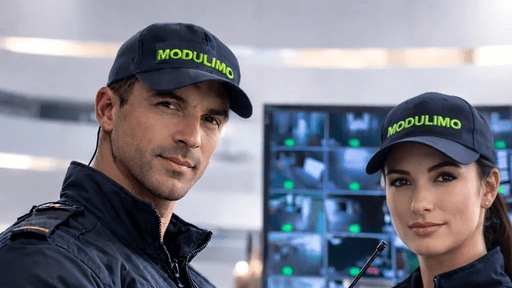
Résidents Modulimo en salle de surveillance
Green level — Daily Continuous surveillance and maintenance
Blue level — Preparedness 72 h kit, family plan and yearly drills
Orange level — Shelter-in-place Emergency protocols and official directives
Flashing indicators during an announced drill · steady indicators in a real situation.
Built-in security

A building designed
for peace of mind.

Security at Modulimo is not an add-on — it is built into the architecture of the building. Every entrance, every shared space and every protocol aims at residents' day-to-day peace of mind, without turning it into a source of worry.

📹
Cameras at shared entrances
Entrances and common areas are shown live. No cameras inside homes or private corridors, and image retention is limited and written down.
🪪
Keycard access
Keycards for the entrance, shared equipment and common areas.
🔒
Fenced grounds
Secure perimeter with controlled access for residents and visitors.
🎓
Resident training
Every resident is trained on the building's emergency protocols upon moving in.
🌿
How homes are allocated
Objective criteria, the same for everyone: ability to pay, rental references and a commitment to the building's rules.
🗓️
Yearly drills
Simulated drills and protocol reviews held each year with residents.
🎤
Themed talks
Information sessions on emergency preparedness, inspired by the “Get Prepared” program.
📋
Evacuation or shelter plan
Depending on the scenario, evacuation to an outside assembly point or shelter at the central refuge. Plan handed to each resident and posted on every floor.
Risks covered

Three sections,
a common framework.

Modulimo prepares its residents for the common situations anticipated by Canadian authorities, following a framework inspired by the French Plans Particuliers de Mise en Sûreté (PPMS). It rests on a named coordination team, a safety kit available on every floor, and a yearly programme of drills and updates.

Blue level · Preparedness

72 h kit and family plan

A single protocol covers radiological emergencies, natural events (storms, climate events) and social unrest around the site. Official triptych of the Canadian government: STAY inside, LISTEN to official media, FOLLOW provincial and municipal directives.

  • Central shelter (core of the building)
  • Sealing of doors, windows and vents
  • Staying away from windows and exterior walls
  • Listening to official radio frequencies
Building automation · planned from the first drawing

A building that keeps watch
when no one is looking.

Protocols, drills and the 72-hour kit cover the exceptional. Building automation covers the ordinary — the leak under the water heater on a Tuesday afternoon, the heating that quits while you are away, the garage door left open. Those are the things that cost money and wake people at three in the morning.

Building automation is home automation at the scale of the building: sensors, a few automations, and a computer in the utility room that ties it together. At Modulimo it is not a late addition: it has been part of the project from the start, like the staircase built for aging well or the central shaft ready for a platform lift. Conduits, rough-ins and sensors go in during construction, because afterwards it means opening walls again.

For a resident it comes down to one sentence: the building takes on what a building can take on, and leaves you the rest.

Does this mean one more app?
No. Everything goes through CoHabitat, the app already used for bookings, shared mobility and shared spaces. Nothing to install: it opens in a browser.
Do I have to manage it?
No. In normal operation it stays out of sight. It becomes visible only when something is out of the ordinary.
And inside my home?
Your home stays yours. The building looks after common areas and infrastructure; whatever you add inside is your call.
What the building does

Three lists — and the third
matters as much as the other two.

It observes
Continuously, with no camera or microphone
  • Water: leaks, abnormal flow, freezing risk
  • Smoke and carbon monoxide
  • Temperature and humidity in common areas
  • Power: outage, restoration, building consumption
  • Doors and access points on the grounds and in the garage
  • Shared equipment: chargers, laundry, greenhouse
It acts on its own
Without waiting for someone to decide
  • Shuts the water valve at the first few millilitres
  • Keeps common areas above freezing during an outage
  • Sets the floor indicators to the right level
  • Alerts the right person — not the whole building
  • Shifts charging and hot water to off-peak hours
  • Keeps a record of what happened, and when
It will never do this
The limits are part of the system
  • No cameras inside homes
  • No data leaving the building
  • No remote control of your home by the operator
  • No neighbour can see your consumption
  • No indefinite retention: the periods are written down
  • No life-safety function entrusted to software: the fire alarm and the lift remain certified, independent systems
Day to day

What it changes,
concretely, for you.

None of these is a gadget: each one removes a chore, a risk or an expense from a household's life.

💧
The water stops before the damage
Water damage is the leading cause of home insurance claims in Quebec. Here a sensor catches it at the first litre and a valve closes — whether you are home or not.
🔋
The car is charged when you leave
The chargers share the available power according to upcoming bookings, not order of arrival. You book it, it is ready.
❄
Winter runs on off-peak hours
Hot water and charging shift away from peak hours while you sleep. You change nothing in your habits; the building handles it.
🏠
The common room is ready when you arrive
Heated and lit a quarter of an hour before your booking, idle the rest of the time. A pleasant space without heating an empty room all week.
🔑
Let someone in without being there
A temporary access right for the plumber, a delivery or the sitter, valid as long as needed and revocable in one move. No more key under the flowerpot.
🚗
The visitor spot is booked ahead
Your guest has a spot, and it is still free when they arrive. The duration is agreed at booking, which prevents the one thing that ruins a visitor spot.
🌱
The greenhouse watches itself
Temperature and tank levels are read continuously and shown in the app — it is already running, and it is the proof that the rest holds up.
🔔
One alert, not a hundred notifications
Each event goes to the person concerned: the resident for their home, the coordination team for the building. Silence is normal operation.
📊
You see what you use
Your own curve, your comparison to the building average, the effect of a habit. For information and for deciding — never to bill you for anything.
Your data

Everything stays
inside the building.

There is no cloud in this story. The sensors talk to a machine installed in the utility room, and that machine is what shows the information in your app. In normal operation, not one byte leaves the building.

When you are away, you reach that same machine through a private tunnel — the route changes, the destination does not.

1
The sensors
Water, temperature, doors, chargers, greenhouse. No image, no sound.
2
The machine in the utility room
It records, decides, alerts. It is here, not somewhere else.
3
Your screen
In CoHabitat, on the building network or through a private tunnel when away.

Who sees what. The detailed data from your home is visible to you alone. The building works only with totals. Retention periods are written down and limited, in line with Quebec's personal information protection law.

The three levels at the top of this page are the screen for all of it.

Green, blue, orange: these are not posters, they are states of the building. Building automation keeps them current, lights the floor indicators — flashing during an announced drill, steady in a real situation — and shows the current instruction in the app. The rest of the time it stays invisible. That is exactly what is asked of it.

ℹ️
Aligned with recognized standards Ces protocoles s'inspirent du programme Préparez-vous of the Canadian government and the framework of the Plans Particuliers de Mise en Sûreté (PPMS) used in France for public-facing establishments. In a real emergency, the official directives of provincial and municipal authorities always prevail. Residents are trained on every procedure before moving in and at yearly drills.